
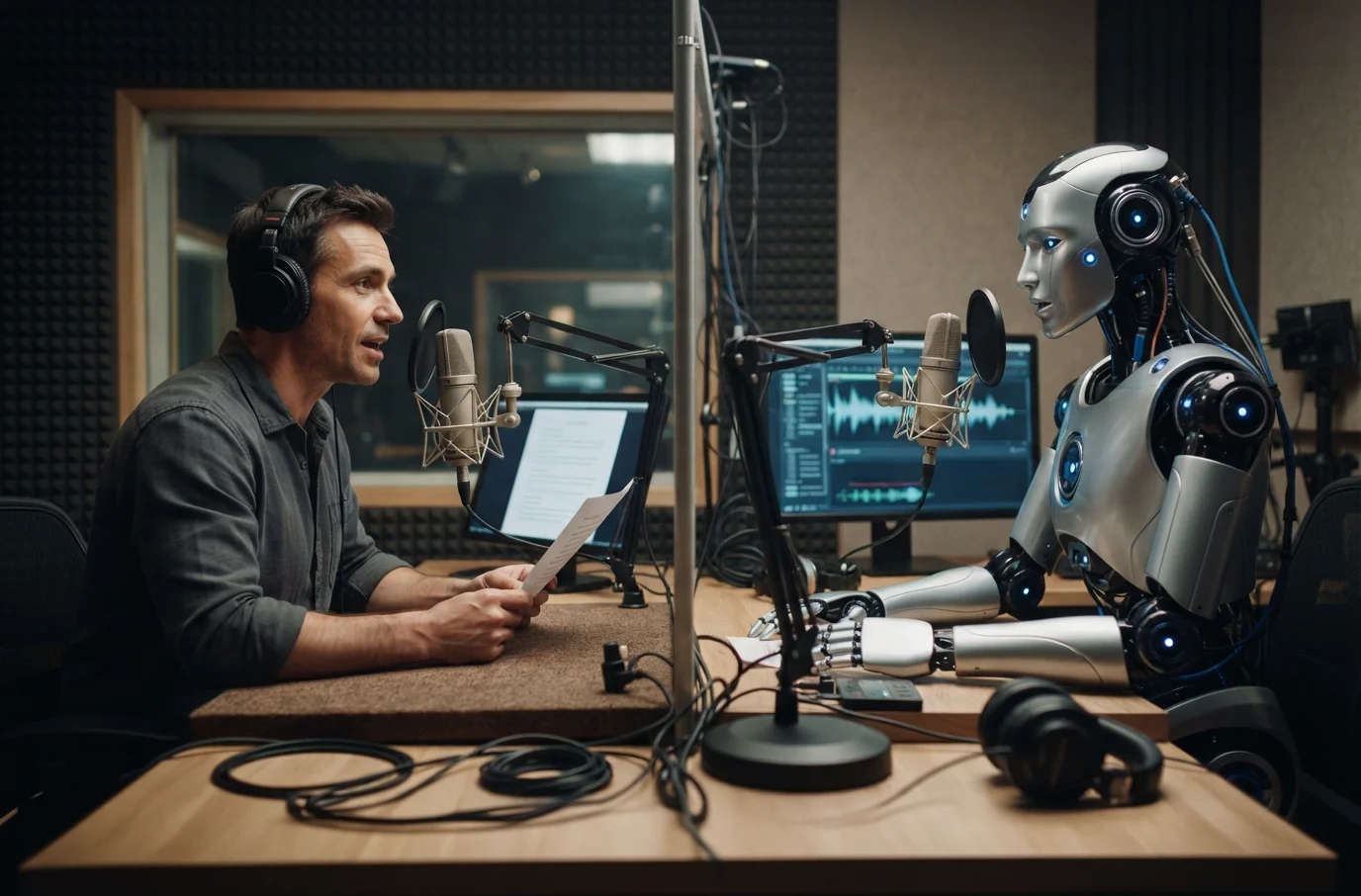
The AI dubbing conversation has shifted. A year ago, the debate was whether AI voice technology was good enough to use at all. In 2026, that question is settled the tools have improved significantly, and AI now plays a role in most professional localization workflows.
But the more important question hasn’t changed: what does “good enough” actually mean for a YouTube channel trying to grow in a new language market?
The answer depends entirely on what you’re optimizing for.
Two Different Problems, Two Different Solutions
AI dubbing is fast and cost-effective at producing a voice track that covers the words. What it still struggles with is the delivery the emotional register, the natural pacing, the way a native speaker lands a joke or shifts tone mid-sentence.
For some content, that gap barely matters. A tutorial with step-by-step instructions and minimal personality is survivable with a clean AI voice. The information still gets through, and viewers can follow along.
For content where the creator’s personality is the product vlogs, commentary, entertainment, storytelling the gap becomes the whole problem. When the voice sounds artificial or off, the connection breaks. Viewers who came because they liked the creator’s energy suddenly feel like they’re watching a different person.
The metric that captures this most clearly is average view duration (AVD). It’s the single best indicator of whether a dubbed audience is genuinely engaging with your content, or just clicking away.
In side-by-side tests on identical videos, the gap between professional human dubbing and low-effort AI dubbing has repeatedly shown a 4x to 5x drop in average view duration. That’s not a small gap. A 5-minute AVD dropping to under a minute tells YouTube, consistently, that the content isn’t resonating and distribution drops accordingly.
Why AI Dubbing Fails Even When It Sounds “Fine”
Here’s a distinction that matters: a dub can sound technically acceptable and still perform badly.
YouTube retention isn’t just about comprehension it’s about engagement. Viewers decide within the first 30–60 seconds whether they’re in for the long haul, and that decision is driven heavily by energy, authenticity, and emotional connection.
A voice that sounds like it’s reading rather than performing fails that test even when every word is correct. Native-language viewers pick up on it in a way that’s hard to name but instantly felt the same way a perfectly grammatical sentence can still read like it was written by someone who doesn’t speak the language.
This matters even more in markets where local content is abundant. A Spanish-speaking viewer in Mexico or Argentina has hundreds of native creators to choose from. If your dubbed content doesn’t feel natural, they leave and find something that does and they won’t run out of options.
Professional human dubbing solves this because skilled voice actors aren’t just translating words they’re performing the content. They match the energy, adapt the delivery for a new audience, and make judgment calls that require cultural knowledge and emotional intelligence an AI model simply doesn’t have.
Where AI Actually Fits in a Professional Workflow
None of this is an argument against AI in dubbing pipelines. It’s an argument against treating AI as a complete replacement for human craft.
In most serious localization workflows, AI earns its place:
- Voice cloning captures a creator’s unique vocal characteristics and carries them into a new language, preserving brand identity.
- Lip-sync alignment tools improve timing so dubbed audio lands naturally with on-screen movement.
- First-pass translation and script drafting dramatically speed up the work that then goes to human reviewers.
The output improves significantly when skilled teams use these tools alongside real QA reviewing pacing, fixing awkward line breaks, adjusting delivery notes, and catching cultural tone-mismatches that automated systems miss every time.
The real difference isn’t AI versus human. It’s how AI is deployed, and who reviews the final output before it reaches a viewer. Used well, AI makes a human team faster. Used as a shortcut to skip the human entirely, it costs you retention.
That’s also why we describe AI voices as faster, not cheaper. The savings show up in turnaround time, not in a stripped-down product. The quality control that actually makes a dub work is exactly the part you can’t automate away.
What “Good Dubbing” Actually Looks Like in the Analytics
When a dub is performing well, a few patterns show up consistently:
Retention holds across the video. The audience retention graph for a localized version should resemble the shape of the original not a sharp early drop-off. If viewers are leaving in the first minute, the dubbing or the language choice is the problem.
AVD improves over time. Newly launched dubbed tracks often get served broadly while the algorithm figures out which viewers respond. Give a new track 60–90 days before drawing conclusions. If AVD trends upward across that window, the content is finding its audience.
Traffic shifts toward Browse and Suggested. When a dub genuinely performs, YouTube starts recommending it. You’ll see traffic sources move away from direct/external and toward Browse Features and Suggested Videos the algorithm’s own signal that it’s found people worth serving the content to.
Dubbed tracks can outperform the original. This surprises creators, but it shouldn’t. If a dub is well-cast and the market was underserved in that language, there’s simply less competition for attention. A strong Spanish or Portuguese dub of quality content can generate more watch time than the English original, because it’s competing for a completely different audience’s attention.
The Language Choice Question
Choosing which languages to dub into matters as much as the quality of the dub itself.
Many creators default to market size (“Spanish is huge, let’s start there”) or CPM (“US English pays well, let’s target Europe next”). Both are reasonable starting points but the stronger signal is already sitting in your own analytics.
Before committing to professional dubbing in a market, check:
- Which countries are already watching your content in meaningful volume?
- Where do your retention rates hold up best among international viewers?
- Are people commenting or sharing your content in languages other than your original?
Existing demand is the most reliable predictor of dubbing performance. When a market is already watching and engaging — even without a localized version — it tells you the content format travels there. A professional dub then removes the one thing standing in the way: the language barrier.
The Honest Bottom Line
AI dubbing has improved, and it will keep improving. It’s a real tool in the localization toolkit today. But the channels generating consistent growth from multilingual content right now are the ones combining professional-quality voice work, human oversight, and cultural adaptation not the ones hitting “generate” and calling it done.
The investment is higher than an automated dub. The returns in audience retention, algorithmic distribution, and viewer loyalty — are proportionally higher too.
At Plugo Studio, we combine human voice talent with AI-assisted workflows to deliver dubbing that feels native to the audience and performs in the analytics. Reach out to talk about your channel, and we’ll walk you through the right approach for your content.